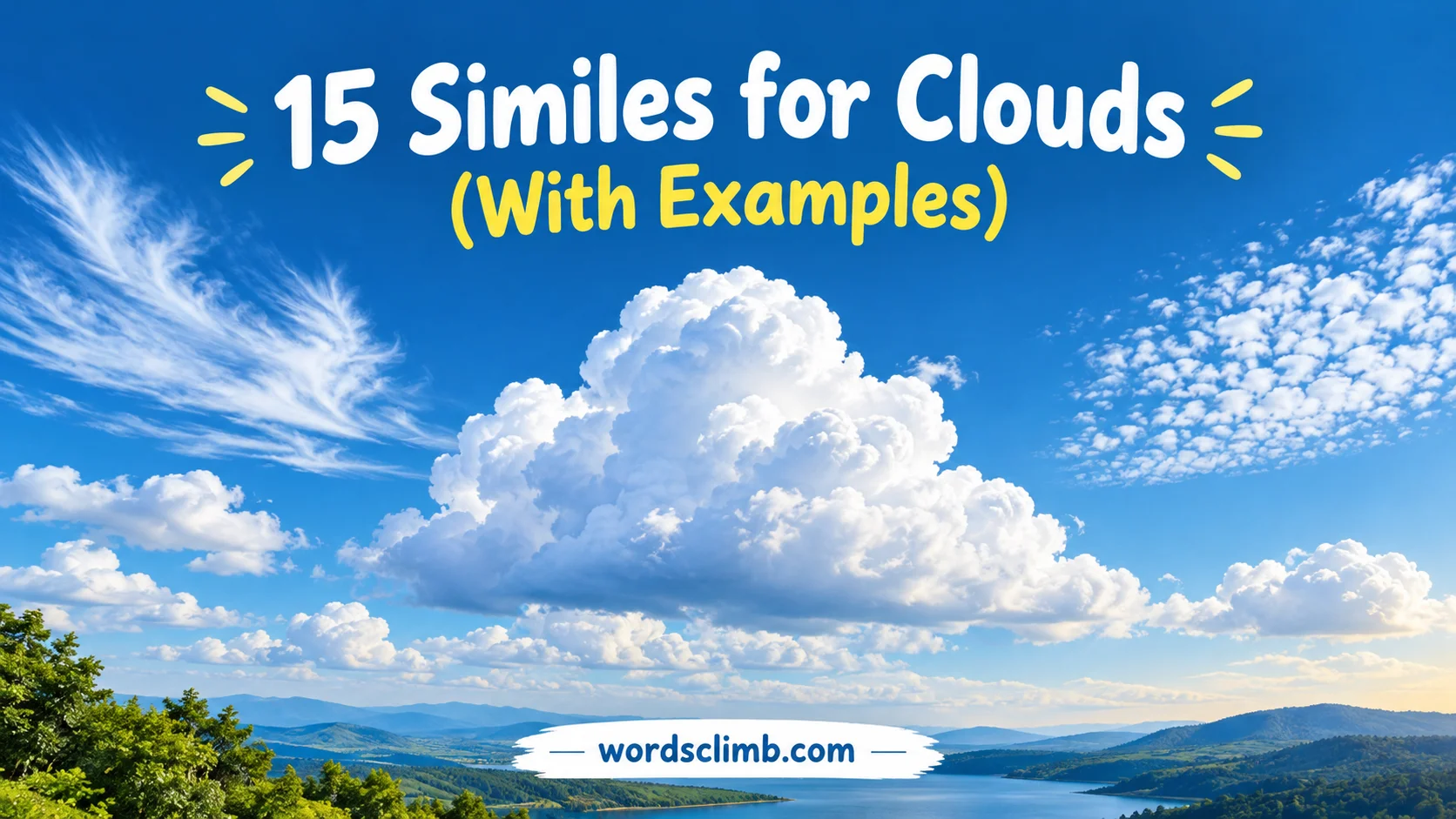
Similes for Clouds (With Examples) help make writing more colorful, vivid, and engaging by comparing clouds to familiar things. These creative comparisons use “like” or “as” to describe the appearance, movement, color, and texture of clouds. For example, clouds can look like cotton balls floating in the sky or feel as soft as fluffy pillows in our imagination. Such expressions help readers create clear mental pictures and understand descriptions more easily.
Clouds have inspired poets, writers, and dreamers for generations because of their changing shapes, peaceful beauty, and mysterious appearance. From white clouds as fluffy as whipped cream to dark storm clouds gathering like an approaching army, each comparison adds emotion and detail to writing. Whether you are working on poetry, storytelling, creative writing, or school assignments, learning these similes can improve your English and make your sentences more interesting. In this guide, you will discover useful cloud similes with simple meanings and practical example sentences.
1. Clouds Like Cotton Balls
Simile: The clouds floated across the sky like cotton balls.
Meaning:
This simile means that the clouds look small, white, fluffy, and soft, similar to pieces of cotton.
Detailed Explanation:
Cotton balls are known for their light, rounded, and delicate appearance. When clouds gather in small, bright formations on a clear day, they may look remarkably similar. This comparison helps readers imagine a peaceful blue sky filled with soft, white shapes.
Writers often use this simile to create a calm, cheerful, and comforting atmosphere. It works especially well in children’s stories, nature descriptions, school essays, and poems about sunny weather. It can also suggest innocence and simplicity.
Example Sentence:
- On the bright summer afternoon, the clouds drifted peacefully across the blue sky like cotton balls scattered over a blanket.
3 Other Ways to Say It:
- The clouds looked like fluffy tufts of cotton.
- The white clouds resembled soft balls of wool.
- The clouds floated like little pillows in the sky.
2. Clouds Like Ships Sailing Across the Sea
Simile: The clouds moved like ships sailing across the sea.
Meaning:
This simile describes clouds drifting slowly through the sky, resembling ships traveling across a vast ocean.
Detailed Explanation:
Ships move steadily across the water, carried by wind and guided by their course. Similarly, clouds can travel across the sky as air currents carry them from one place to another. This comparison makes the sky appear like a huge ocean, with clouds serving as magnificent sailing vessels.
The expression creates a sense of movement, freedom, and adventure. It is particularly useful when describing large clouds passing above a coastal town, an open field, or a wide landscape. Writers can use it to make an ordinary sky feel like a scene from an imaginative journey.
Example Sentence:
- From the hilltop, we watched the great white clouds glide overhead like ships sailing across the sea.
3 Other Ways to Say It:
- The clouds drifted like boats on a blue ocean.
- The clouds sailed across the heavens like mighty vessels.
- The clouds traveled through the sky like ships carried by gentle winds.
3. Clouds as Dark as Charcoal
Simile: The storm clouds were as dark as charcoal.
Meaning:
This simile describes very dark gray or nearly black clouds that often appear before a storm.
Detailed Explanation:
Charcoal has a deep, dark color that makes it a useful comparison for heavy storm clouds. When the sky becomes covered with thick clouds, sunlight may disappear, leaving the surroundings looking dim and shadowy.
This simile can create a feeling of tension, uncertainty, or approaching danger. It works well in stories about thunderstorms, dramatic weather scenes, and poems that explore sadness or suspense. Although the comparison focuses on color, it can also help establish a darker mood.
Example Sentence:
- As the wind grew stronger, clouds gathered above the village, as dark as charcoal, warning everyone of the approaching storm.
3 Other Ways to Say It:
- The clouds looked like blackened smoke.
- The storm clouds were as dark as soot.
- Heavy clouds spread across the sky like a blanket of darkness.
4. Clouds Like Mountains in the Sky
Simile: The towering clouds rose like mountains in the sky.
Meaning:
This simile compares large, tall clouds with mountains because of their height, size, and impressive shapes.
Detailed Explanation:
Some clouds grow into enormous formations with rounded tops and broad bases. Their shapes can resemble mountain ranges rising above the horizon. This is particularly noticeable when towering cumulus clouds develop on warm days.
The comparison emphasizes the grandeur and scale of the natural world. It can make a landscape seem more dramatic and help readers visualize the impressive height of the clouds. Writers may use it in travel descriptions, adventure stories, and nature essays to communicate a sense of wonder.
Example Sentence:
- Beyond the green valley, towering white clouds rose like mountains in the sky, their bright peaks glowing in the afternoon sunlight.
3 Other Ways to Say It:
- The clouds stood like giant peaks above the horizon.
- The clouds resembled snowy mountain ranges.
- Towering clouds climbed upward like enormous hills.
5. Clouds as Soft as Wool
Simile: The clouds looked as soft as wool.
Meaning:
This simile describes clouds that appear gentle, fluffy, and delicate, reminding the observer of wool.
Detailed Explanation:
Wool is associated with warmth, softness, and a textured appearance. Clouds with rounded edges and layered shapes can create a similar impression when viewed from the ground. Although clouds are made of tiny water droplets or ice crystals rather than wool, their appearance can inspire this comparison.
This phrase is helpful when writing about a peaceful morning, a pleasant afternoon, or a quiet natural scene. It gives the sky a comforting quality and encourages readers to imagine a gentle texture. It can also add warmth to descriptive passages without making the language complicated.
Example Sentence:
- The children lay on the grass and watched clouds as soft as wool slowly pass above them.
3 Other Ways to Say It:
- The clouds looked like soft wool blankets.
- The clouds appeared as fluffy as a wool sweater.
- The white clouds resembled tufts of gentle fleece.
6. Clouds Like Brushstrokes on a Canvas
Simile: The clouds stretched across the sky like brushstrokes on a canvas.
Meaning:
This simile compares clouds with artistic brushstrokes, emphasizing their shapes, patterns, and arrangement in the sky.
Detailed Explanation:
An artist creates a painting by placing brushstrokes across a canvas. Nature sometimes creates a similar effect when thin clouds form delicate lines, streaks, or scattered patterns across the sky. The result can look like a painting created by an invisible artist.
This comparison is especially effective for describing high, wispy clouds or colorful skies at sunrise and sunset. It adds an artistic quality to writing and encourages readers to notice the details of the natural world. It also suggests that even an ordinary view can become a beautiful work of art.
Example Sentence:
- At sunset, pale pink clouds spread above the mountains like brushstrokes on a canvas, turning the entire horizon into a painting.
3 Other Ways to Say It:
- The clouds stretched like painted lines across the sky.
- The clouds resembled delicate strokes from an artist’s brush.
- Wispy clouds decorated the heavens like marks on a giant canvas.
7. Clouds Like Giant Pillows
Simile: The clouds looked like giant pillows floating overhead.
Meaning:
This simile describes large, rounded clouds that appear plump, fluffy, and soft, similar to oversized pillows.
Detailed Explanation:
Pillows are familiar objects associated with comfort and relaxation. When clouds form thick, rounded shapes with bright tops, they may remind observers of pillows suspended high above the earth. This image makes the sky feel welcoming and peaceful.
The phrase works particularly well in children’s writing, bedtime stories, and cheerful descriptions of clear weather. It can also express a feeling of comfort or daydreaming. In creative writing, the comparison gives readers a familiar image that makes an enormous natural scene easier to picture.
Example Sentence:
- On our family picnic, the clouds rested above the meadow like giant pillows, inviting us to lie back and watch them drift.
3 Other Ways to Say It:
- The clouds resembled enormous cushions in the sky.
- White clouds floated like oversized pillows.
- The clouds looked like soft cushions suspended overhead.
8. Clouds Like Waves of Foam
Simile: The clouds rolled across the horizon like waves of foam.
Meaning:
This simile compares groups of white clouds with foamy ocean waves, highlighting their curved shapes and flowing appearance.
Detailed Explanation:
Ocean waves often form white foam along their crests, creating a pattern of rounded and overlapping shapes. Certain cloud formations can look similar, especially when their edges cluster together across a wide stretch of sky.
This comparison connects the sky with the sea and makes a description feel more dynamic. It works well in writing about coastal landscapes, breezy afternoons, and dramatic natural scenery. The phrase can suggest movement even when the clouds are drifting slowly.
Example Sentence:
- White clouds gathered above the distant cliffs like waves of foam, creating a beautiful pattern against the deep blue sky.
3 Other Ways to Say It:
- The clouds spread like frothy waves above the land.
- White clouds tumbled overhead like ocean foam.
- The cloud formations resembled rolling waves on a distant sea.
Also Read This: 15 Metaphors for Anger (With Examples)
9. Clouds Like a Flock of Sheep
Simile: The little clouds scattered across the sky like a flock of sheep.
Meaning:
This simile compares small, rounded cloud formations with a group of sheep gathered together in a field.
Detailed Explanation:
When numerous small clouds appear close together, their rounded shapes can resemble sheep standing in a flock. They may seem to gather in groups, leave spaces between one another, and stretch far across the sky.
This image creates a gentle, pastoral feeling, bringing to mind open fields, quiet countryside, and peaceful afternoons. It is particularly useful in descriptive writing because readers can easily picture the arrangement of the clouds.
Example Sentence:
- Tiny white clouds dotted the pale blue sky like a flock of sheep grazing in a vast meadow.
3 Other Ways to Say It:
- The clouds gathered like sheep in a pasture.
- Small clouds clustered like a herd of woolly animals.
- White clouds dotted the heavens like sheep scattered across a hillside.
10. Clouds as Gray as Ashes
Simile: The clouds were as gray as ashes.
Meaning:
This simile describes clouds with a dull, smoky gray color, similar to the remains of burned wood or other materials.
Detailed Explanation:
Ashes often have a pale or medium-gray appearance. When sunlight is blocked by thick clouds, the sky can take on a similar muted color. This comparison is useful for describing gloomy weather, a cold morning, or the hours before rain begins.
Unlike a bright comparison involving white clouds, this simile creates a subdued atmosphere. It can help communicate stillness, melancholy, uncertainty, or the heaviness of an approaching storm. The effect depends on the surrounding details and the mood of the writing.
Example Sentence:
- By late afternoon, the clouds had spread over the town, as gray as ashes, and the streets looked unusually quiet.
3 Other Ways to Say It:
- The clouds were as pale gray as fireplace ash.
- A layer of smoky clouds covered the sky.
- The clouds resembled drifting ash above the rooftops.
11. Clouds Like a Veil Over the Sun
Simile: Thin clouds spread like a veil over the sun.
Meaning:
This simile describes clouds that partially cover the sun, making its light appear soft, faint, or diffused.
Detailed Explanation:
A veil is a thin covering that allows some light or shapes to remain visible beneath it. High, thin clouds can have a similar effect when they pass between the observer and the sun. The sunlight remains present but loses some of its brightness.
This phrase is ideal for describing hazy afternoons, soft morning light, and delicate changes in weather. It creates a subtle atmosphere instead of presenting the sky as completely clear or completely overcast. Writers can also use it metaphorically to suggest something partially hidden.
Example Sentence:
- By midmorning, a thin layer of clouds had spread like a veil over the sun, softening the light across the garden.
3 Other Ways to Say It:
- The clouds covered the sun like a thin curtain.
- Wispy clouds drifted across the sunlight like translucent fabric.
- A delicate layer of clouds rested over the sun like a sheer covering.
12. Clouds as Golden as Honey
Simile: The clouds were as golden as honey.
Meaning:
This simile describes clouds glowing with warm golden, yellow, or amber colors, especially around sunrise or sunset.
Detailed Explanation:
Honey has a rich golden color that can resemble the warm light reflected from clouds near the horizon. When the sun sits low in the sky, its light can illuminate clouds in shades of gold, orange, and amber.
This comparison creates a feeling of warmth, beauty, happiness, and wonder. It is particularly useful in poems, travel writing, romantic descriptions, and stories that feature peaceful evenings. The phrase helps readers visualize the changing colors of the atmosphere as daylight fades.
Example Sentence:
- As the sun sank behind the hills, the clouds turned as golden as honey, spreading a warm glow across the quiet countryside.
3 Other Ways to Say It:
- The clouds shone like golden syrup in the evening light.
- The sunset clouds glowed like polished amber.
- The clouds looked as warm and golden as melted honey.
13. Clouds Like Drifting Islands
Simile: The clouds floated through the sky like drifting islands.
Meaning:
This simile compares separate clouds with islands moving across a vast blue ocean.
Detailed Explanation:
Islands appear as distinct pieces of land surrounded by water. Similarly, individual clouds can seem separated from one another by broad areas of blue sky. This visual arrangement can make the sky resemble an endless ocean with white islands suspended above it.
The comparison emphasizes space, distance, imagination, and peaceful movement. It is an excellent choice for travel descriptions, imaginative stories, and writing about wide-open landscapes. It also encourages readers to think about clouds as separate forms rather than a single covering over the sky.
Example Sentence:
- Looking through the airplane window, we watched the clouds spread beneath us like drifting islands in an endless blue ocean.
3 Other Ways to Say It:
- The clouds appeared like islands scattered across a blue sea.
- White clouds floated like distant lands in the heavens.
- The clouds resembled small islands resting above an invisible ocean.
14. Clouds as Light as Feathers
Simile: The wispy clouds looked as light as feathers.
Meaning:
This simile describes clouds that appear delicate, airy, and almost weightless, similar to feathers carried by a breeze.
Detailed Explanation:
Feathers are light objects that can move gently through the air. Thin, wispy clouds often have a similarly delicate appearance, especially when they stretch into narrow, feathery shapes high above the earth.
This comparison creates a sense of lightness, grace, and freedom. It works particularly well when describing cirrus clouds, which often appear as fine, hairlike streaks in the upper atmosphere. Writers can use this phrase when they want a description to feel calm rather than heavy or dramatic.
Example Sentence:
- Delicate white clouds stretched across the morning sky as light as feathers drifting on a gentle breeze.
3 Other Ways to Say It:
- The wispy clouds floated like feathers in the wind.
- The clouds looked as weightless as a bird’s down.
- Thin clouds drifted overhead like delicate plumes.
15. Clouds Like a Blanket Covering the Earth
Simile: Thick clouds spread across the sky like a blanket covering the earth.
Meaning:
This simile describes widespread cloud cover that seems to stretch continuously across the sky, much like a blanket covering a surface.
Detailed Explanation:
A blanket covers a large area and can create a feeling of shelter or enclosure. When clouds merge into a broad, continuous layer, they can appear to wrap the landscape in a similar way. The sky may look uniformly gray, and the sunlight may become weaker or disappear entirely.
This simile is useful for describing overcast days, winter weather, and skies before rainfall. Depending on the context, it can create a cozy, peaceful feeling or emphasize the heavy, gloomy atmosphere. Details about the temperature, wind, and surrounding landscape can make the comparison even more effective.
Example Sentence:
- By evening, thick clouds stretched from one horizon to the other like a blanket covering the earth, hiding the sun and dimming the distant hills.
3 Other Ways to Say It:
- The clouds covered the heavens like a vast quilt.
- A thick layer of clouds wrapped the sky like a blanket.
- Gray clouds spread overhead like a cover across the landscape.
MCQs
1. Which sentence contains a simile for clouds?
A. The clouds covered the sky.
B. The clouds were white.
C. The clouds floated like cotton balls.
D. The clouds moved slowly.
2. Which word is commonly used to introduce a simile?
A. Because
B. Like
C. Although
D. Therefore
3. What does “The storm clouds were as dark as charcoal” describe?
A. The clouds’ color
B. The clouds’ sweetness
C. The clouds’ temperature
D. The clouds’ sound
4. Which comparison best describes large, towering clouds?
A. Clouds like tiny seeds
B. Clouds like mountains in the sky
C. Clouds like drops of water
D. Clouds like grains of sand
5. “The clouds looked as soft as wool” suggests that the clouds appear:
A. Rough and sharp
B. Heavy and metallic
C. Gentle and fluffy
D. Bright red
6. Which simile creates an image of clouds moving across the sky like vessels?
A. Clouds like ships sailing across the sea
B. Clouds as cold as ice
C. Clouds like broken stones
D. Clouds as bright as lamps
7. What do clouds like brushstrokes on a canvas suggest?
A. An artistic pattern in the sky
B. A loud storm
C. A completely black sky
D. Clouds that smell like paint
8. Which simile is most suitable for a warm, golden sunset?
A. Clouds as dark as charcoal
B. Clouds as golden as honey
C. Clouds like gray ashes
D. Clouds like black smoke
9. In “The clouds scattered like a flock of sheep,” what is being compared?
A. Clouds and birds
B. Clouds and trees
C. Clouds and a group of sheep
D. Clouds and boats
10. What does “Thin clouds spread like a veil over the sun” suggest?
A. The sun has disappeared permanently.
B. The clouds are partially softening the sunlight.
C. The clouds are falling to the ground.
D. The sky is completely cloudless.
11. Which simile best describes delicate, wispy clouds?
A. Clouds as heavy as stones
B. Clouds like iron chains
C. Clouds as light as feathers
D. Clouds like wooden planks
12. “The clouds floated like drifting islands” creates an image of:
A. Separate clouds against a broad sky
B. Clouds producing loud sounds
C. Clouds changing into land
D. Clouds falling like rain
13. Which comparison is most suitable for a thick, overcast sky?
A. Clouds like a blanket covering the earth
B. Clouds like tiny diamonds
C. Clouds as bright as candles
D. Clouds like colorful balloons
14. Which sentence uses “as” to form a simile?
A. The clouds covered the mountain.
B. The sky became dark.
C. The clouds were as gray as ashes.
D. The wind moved the clouds.
15. Why do writers use similes for clouds?
A. To make descriptions more vivid and engaging
B. To remove all descriptive details
C. To make every sentence longer
D. To explain mathematical calculations
Answers
- C — The clouds floated like cotton balls.
- B — Like is commonly used to introduce a simile.
- A — The comparison describes the clouds’ dark color.
- B — Mountains suggest height and impressive size.
- C — Wool suggests a soft, fluffy appearance.
- A — Ships sailing across the sea communicate movement.
- A — Brushstrokes suggest an artistic pattern.
- B — Honey represents the warm, golden color.
- C — The clouds are compared with a flock of sheep.
- B — A veil suggests a thin covering that softens sunlight.
- C — Feathers suggest delicacy and lightness.
- A — Drifting islands suggest separate clouds across a wide sky.
- A — A blanket represents widespread cloud cover.
- C — “As gray as ashes” uses the word “as” to form a simile.
- A — Similes make descriptions more vivid and engaging.
FAQs:
1. What is a simile for clouds?
A simile for clouds compares clouds to something familiar using the words “like” or “as.” For example, “The clouds floated like cotton balls across the sky.”
2. What is a common simile for clouds?
A common simile is “Clouds are like cotton balls.” It describes the soft, fluffy, and white appearance of clouds in the sky.
3. How do you describe clouds using similes?
You can describe clouds by comparing their appearance, color, or movement to familiar objects. For example, “The clouds were as fluffy as pillows” describes their softness, while “The dark clouds gathered like an approaching army” suggests an incoming storm.
4. Why are similes for clouds useful in writing?
Similes help make descriptive writing more vivid and interesting. They allow readers to imagine the clouds clearly and help writers express feelings, moods, and natural beauty through creative comparisons.
5. What are some examples of similes for dark clouds?
Here are three examples of similes for dark clouds:
- The dark clouds gathered like an approaching army.
- The storm clouds were as black as charcoal.
- The clouds rolled across the sky like a dark blanket.
These comparisons create a sense of mystery, heaviness, or an approaching storm.
Conclusion:
Similes for Clouds make writing more vivid, creative, and enjoyable. By comparing clouds to familiar things like cotton balls, pillows, whipped cream, or approaching armies, you can describe their shapes, colors, movement, and appearance in simple yet powerful ways. These expressions are useful for poetry, storytelling, descriptive writing, and everyday English. Learning different cloud similes can help you express your ideas clearly and create beautiful mental pictures for your readers. Practice using these comparisons in your own sentences to make your writing more engaging and memorable.

Ruby Hart is a passionate writer who creates engaging, relatable, and easy-to-understand content. She loves turning everyday ideas into helpful and enjoyable stories for readers.












1 thought on “15 Similes for Clouds (With Examples)”