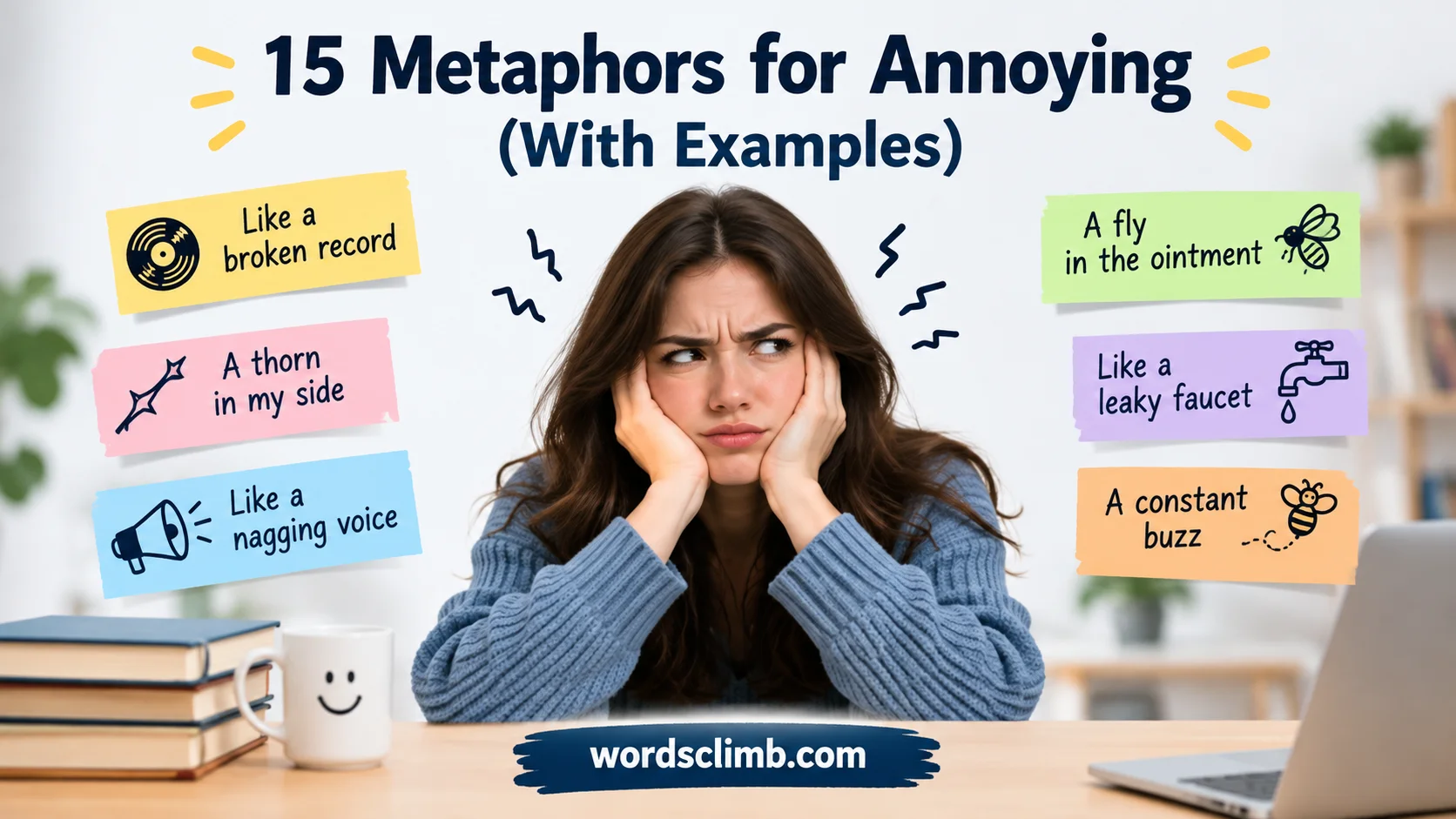
Metaphors for Annoying (With Examples) help you describe irritating people, noisy sounds, frustrating habits, and uncomfortable situations in a more creative and expressive way. Sometimes, the word annoying is not enough to explain how something makes you feel. For example, calling someone a mosquito buzzing in your ear creates a clear picture of a person who constantly bothers you. These metaphors make your words more interesting, memorable, and easier for readers to understand.
In this guide, you will discover creative metaphors for annoying people, behaviors, sounds, and situations, along with their simple meanings and practical examples. Whether you are a student, teacher, writer, or language learner, these expressions can help you communicate irritation more effectively. You will also learn how to use funny, sarcastic, and powerful metaphors in everyday conversations, essays, stories, and social media posts while making your writing sound natural and engaging.
1. A Mosquito in Your Ear
Meaning: Something that constantly irritates or distracts you.
Detailed Explanation:
A mosquito buzzing around your ear can be incredibly irritating because it makes a persistent noise and refuses to leave you alone. This metaphor describes a person, habit, or situation that repeatedly interrupts your peace. It works particularly well when you want to describe small but continuous annoyances.
Example Sentence:
- His constant complaints were a mosquito in my ear throughout the entire meeting.
- The repeated notifications became a mosquito in her ear while she was studying.
- My little brother’s endless questions were a mosquito in my ear during my favorite show.
3 Other Ways to Say It:
- A constant irritation
- An endless distraction
- A persistent nuisance
2. A Broken Record
Meaning: Someone or something that repeats the same thing over and over.
Detailed Explanation:
A broken record traditionally repeats the same section of music because it cannot move forward. This metaphor describes people who repeat the same complaints, arguments, warnings, or questions without adding anything new. It is especially useful when repetition becomes frustrating.
Example Sentence:
- My coworker sounded like a broken record, repeating the same complaint every morning.
- Mom became a broken record when she reminded me to clean my room.
- The politician’s speech was a broken record of promises we had already heard.
3 Other Ways to Say It:
- A repeating loop
- A stuck recording
- The same old story
3. A Thorn in My Side
Meaning: A person or situation that causes ongoing trouble or irritation.
Detailed Explanation:
A thorn in your side causes discomfort whenever you move, making it a powerful image for a persistent problem. This metaphor is often used for an irritating habit, a difficult task, or a recurring obstacle that makes life more complicated than it needs to be.
It can express frustration without directly insulting someone, especially when the annoyance comes from a repeated behavior rather than a person’s entire character.
Example Sentence:
- The unreliable software has been a thorn in my side for months.
- His habit of arriving late became a thorn in the team’s side.
- The unfinished paperwork was a thorn in her side all week.
3 Other Ways to Say It:
- A constant headache
- A persistent problem
- An ongoing nuisance
4. A Fly in the Soup
Meaning: Something irritating that spoils an otherwise pleasant experience.
Detailed Explanation:
Finding a fly in your soup can ruin an enjoyable meal. This metaphor describes a small but unwelcome problem that interferes with something that should have been pleasant. It is useful when a minor annoyance changes the mood of an event, outing, or experience.
Example Sentence:
- The unexpected argument was a fly in the soup at our family celebration.
- The constant advertisements were a fly in the soup during an otherwise enjoyable movie.
- One rude comment became a fly in the soup at an otherwise lovely dinner.
3 Other Ways to Say It:
- A spoilsport
- An unwelcome interruption
- A disappointing distraction
5. A Siren That Never Sleeps
Meaning: Something that produces constant, irritating noise or demands attention.
Detailed Explanation:
A siren is designed to attract attention through a loud, persistent sound. Comparing an annoying noise or attention-seeking behavior to a siren that never sleeps emphasizes how difficult it is to ignore. This metaphor is especially effective for creative writing about noisy surroundings or continuous interruptions.
Example Sentence:
- The construction site outside my window was a siren that never sleeps.
- His phone sounded like a siren that never sleeps during our road trip.
- The alarm in the next room became a siren that never sleeps throughout the night.
3 Other Ways to Say It:
- A nonstop alarm
- A wall of noise
- A relentless disturbance
6. A Cloud Over My Day
Meaning: Something that makes an otherwise pleasant day frustrating or unpleasant.
Detailed Explanation:
Clouds can cover the sunlight and change the atmosphere of a beautiful day. In the same way, an annoying event or behavior can affect your mood and make it harder to enjoy your surroundings. This metaphor is useful when you want to express disappointment or irritation in a gentle, emotional way.
Example Sentence:
- The constant criticism became a cloud over my day.
- The argument with my friend was a cloud over an otherwise happy afternoon.
- The repeated delays cast a cloud over our vacation plans.
3 Other Ways to Say It:
- A shadow over my mood
- A mood dampener
- A cloud over my happiness
7. Sand in My Shoes
Meaning: A small but persistent annoyance that makes an experience uncomfortable.
Detailed Explanation:
A little sand inside your shoes can make every step uncomfortable. Although it may seem insignificant, the irritation continues until you remove it. This metaphor describes minor problems that repeatedly disturb your comfort, concentration, or peace of mind.
It is particularly useful when an annoyance is not serious enough to cause a major problem but remains difficult to ignore.
Example Sentence:
- The constant tapping of his pen was sand in my shoes during the lecture.
- Those tiny scheduling changes became sand in my shoes throughout the project.
- Her habit of interrupting conversations was sand in my shoes.
3 Other Ways to Say It:
- A nagging irritation
- A small but persistent bother
- A constant discomfort
8. A Buzzing Beehive
Meaning: A place or situation filled with distracting noise and restless activity.
Detailed Explanation:
A beehive can be full of movement, buzzing, and activity. When a room or environment resembles a buzzing beehive, it suggests that the noise and constant movement have become distracting or overwhelming. This metaphor is useful for describing crowded offices, noisy classrooms, or busy public spaces.
Example Sentence:
- The classroom turned into a buzzing beehive before the teacher arrived.
- Our office was a buzzing beehive during the last hour before the deadline.
- The crowded waiting room felt like a buzzing beehive.
3 Other Ways to Say It:
- A noisy crowd
- A hive of activity
- A whirlwind of commotion
9. A Leaky Faucet
Meaning: A small, repetitive irritation that continues without stopping.
Detailed Explanation:
A leaky faucet may produce only a tiny drop of water at a time, but its repetitive sound can become frustrating. This metaphor represents habits or situations that repeatedly interrupt your attention. It works well for describing dripping sounds, recurring notifications, or people who make frequent unnecessary comments.
Example Sentence:
- The dripping tap was a leaky faucet of frustration while I tried to sleep.
- His repeated little remarks became a leaky faucet of distractions during the meeting.
- The constant alerts on my phone felt like a leaky faucet that never stopped dripping.
3 Other Ways to Say It:
- A constant drip of irritation
- A recurring distraction
- A never-ending trickle of trouble
10. A Stone in My Shoe
Meaning: A persistent problem that causes discomfort and makes progress difficult.
Detailed Explanation:
A stone trapped inside your shoe makes walking uncomfortable and forces you to think about the problem with every step. Similarly, an annoying issue can interfere with your daily routine and prevent you from concentrating on more important things.
This metaphor is effective when a relatively small issue keeps returning and needs to be addressed before you can move forward comfortably.
Example Sentence:
- The unresolved misunderstanding was a stone in my shoe throughout the project.
- The printer’s constant malfunctions became a stone in my shoe at work.
- His habit of changing plans at the last minute was a stone in my shoe.
3 Other Ways to Say It:
- A nagging problem
- An uncomfortable obstacle
- A persistent inconvenience
Read This: 15 Metaphors for Arguing (With Examples)
11. A Drum That Never Stops
Meaning: A continuous noise, complaint, or demand that becomes irritating.
Detailed Explanation:
A drum can create a powerful rhythm, but the sound may become exhausting when it continues without a break. This metaphor describes repeated complaints, loud activities, or persistent demands that leave little room for quiet or concentration.
It is especially useful when you want to emphasize the exhausting nature of an ongoing annoyance.
Example Sentence:
- The construction workers outside sounded like a drum that never stops.
- His complaints were a drum that never stops whenever something went wrong.
- The constant knocking became a drum that never stops in the otherwise quiet house.
3 Other Ways to Say It:
- A relentless beat
- A nonstop disturbance
- A continuous barrage of noise
12. A Fly Circling a Lamp
Meaning: Someone or something that repeatedly returns and refuses to leave you in peace.
Detailed Explanation:
A fly circling a lamp may repeatedly return to the same place, even when it seems to have disappeared. This image can describe an unwanted interruption, a recurring question, or a person who keeps returning to a subject after everyone else has moved on.
The metaphor communicates irritation through a familiar image without requiring aggressive language.
Example Sentence:
- His repeated questions felt like a fly circling a lamp while I was trying to work.
- The same argument returned like a fly circling a lamp.
- Every time we changed the subject, her complaint came back like a fly circling a lamp.
3 Other Ways to Say It:
- A recurring interruption
- An unwanted distraction
- A persistent pest
13. A Traffic Jam in My Mind
Meaning: Something that creates frustration, confusion, or difficulty concentrating.
Detailed Explanation:
A traffic jam prevents vehicles from moving freely. Similarly, repeated interruptions, unnecessary arguments, or overwhelming distractions can block your thoughts and make it difficult to focus. This metaphor is particularly effective for explaining how annoying situations affect concentration and mental clarity.
It can also describe the frustration of trying to complete a task while too many things compete for your attention.
Example Sentence:
- The constant interruptions created a traffic jam in my mind while I was writing.
- Trying to answer everyone’s questions at once felt like a traffic jam in my mind.
- The noisy environment turned my thoughts into a traffic jam.
3 Other Ways to Say It:
- A mental roadblock
- A jumble of distractions
- A bottleneck of thoughts
14. A Scratched Record Player
Meaning: A repetitive behavior or sound that becomes increasingly irritating.
Detailed Explanation:
A scratched record player can repeat a sound or skip at the same point in a song. This metaphor describes a person who repeats the same complaint or a noise that continues to interrupt your peace. Unlike a broken record, this expression can place more emphasis on the irritating interruption itself.
It is useful in informal writing and everyday conversation when you want to communicate that repetition has become exhausting.
Example Sentence:
- His constant excuses sounded like a scratched record player.
- The old machine was a scratched record player of irritating clicks and pauses.
- Every discussion ended with the same argument, like a scratched record player.
3 Other Ways to Say It:
- A stuck song
- A repetitive nuisance
- The same irritating refrain
15. A Pebble in the Engine
Meaning: A small but troublesome issue that disrupts the smooth operation of something.
Detailed Explanation:
An engine needs its parts to work together smoothly. Imagining a pebble interfering with that process creates a vivid picture of a minor issue causing disproportionate frustration. This metaphor can describe an annoying habit that disrupts teamwork, an inconvenient technical problem, or a small obstacle that slows progress.
It is particularly useful when a little problem affects an otherwise well-organized system.
Example Sentence:
- The repeated last-minute changes were a pebble in the engine of our project.
- The faulty login system became a pebble in the engine of our daily workflow.
- His habit of interrupting colleagues was a pebble in the engine of effective teamwork.
3 Other Ways to Say It:
- A stumbling block
- A disruptive obstacle
- A small but troublesome complication
MCQs
1. Which metaphor describes someone who repeats the same complaint again and again?
- A. A cloud over my day
- B. A broken record
- C. A buzzing beehive
- D. A pebble in the engine
2. What does “a thorn in my side” mean?
- A. A pleasant surprise
- B. A temporary celebration
- C. A persistent source of trouble
- D. A helpful suggestion
3. Which metaphor describes a small but continuous irritation?
- A. Sand in my shoes
- B. A clear blue sky
- C. A shining star
- D. A peaceful river
4. What does “a fly in the soup” describe?
- A. A delicious meal
- B. A small problem that spoils an experience
- C. A relaxing afternoon
- D. A successful event
5. Which metaphor best describes constant, distracting noise?
- A. A siren that never sleeps
- B. A gentle breeze
- C. A quiet garden
- D. A warm blanket
6. What does “a cloud over my day” suggest?
- A. A perfect morning
- B. A refreshing shower
- C. Something that negatively affects your mood
- D. A successful achievement
7. Which metaphor describes a noisy and busy environment?
- A. A sleeping kitten
- B. A buzzing beehive
- C. A still pond
- D. A silent room
8. What does “a leaky faucet” symbolize in this article?
- A. A one-time surprise
- B. A permanent solution
- C. A small, repetitive annoyance
- D. A joyful celebration
9. Which expression describes a problem that makes every step uncomfortable?
- A. A stone in my shoe
- B. A rainbow in the sky
- C. A light at the end of the tunnel
- D. A breath of fresh air
10. What does “a drum that never stops” suggest?
- A. A brief moment of silence
- B. A continuous and irritating sound
- C. A relaxing melody
- D. A peaceful evening
11. Which metaphor describes an interruption that repeatedly returns?
- A. A fly circling a lamp
- B. A bird flying away
- C. A door opening
- D. A candle burning
12. What does “a traffic jam in my mind” describe?
- A. Excellent concentration
- B. Clear thinking
- C. Mental confusion caused by distractions
- D. A productive morning
13. Which expression emphasizes an irritating sound that repeats or skips?
- A. A scratched record player
- B. A flowing waterfall
- C. A peaceful breeze
- D. A bright sunrise
14. What does “a pebble in the engine” represent?
- A. A major success
- B. A small problem that disrupts progress
- C. A valuable reward
- D. A perfect plan
15. Which metaphor would best describe repeated interruptions while studying?
- A. A mosquito in your ear
- B. A shining moon
- C. A warm embrace
- D. A peaceful meadow
Answer
- B — A broken record
- C — A persistent source of trouble
- A — Sand in my shoes
- B — A small problem that spoils an experience
- A — A siren that never sleeps
- C — Something that negatively affects your mood
- B — A buzzing beehive
- C — A small, repetitive annoyance
- A — A stone in my shoe
- B — A continuous and irritating sound
- A — A fly circling a lamp
- C — Mental confusion caused by distractions
- A — A scratched record player
- B — A small problem that disrupts progress
- A — A mosquito in your ear
FAQs:
1. What is a metaphor for annoying?
A metaphor for annoying describes an irritating person, sound, or situation by comparing it directly to something else. For example, “He is a mosquito in my ear” describes someone who constantly bothers you.
2. What is a good metaphor for an annoying person?
A good metaphor is “a broken record.” It describes someone who keeps repeating the same words, complaints, or stories and becomes irritating to others.
3. What is a funny metaphor for annoying?
A funny metaphor is “a walking alarm clock.” It can describe someone who constantly makes noise, interrupts others, or refuses to let people enjoy some peace and quiet.
4. How do metaphors help describe annoyance?
Metaphors create clear mental images that help readers understand irritation more easily. They make descriptions more colorful, memorable, and expressive than simply using the word annoying.
5. What is the difference between a metaphor and a simile for annoying?
A metaphor directly compares two things, such as “He is a mosquito.” A simile uses “like” or “as,” such as “He is like a mosquito.” Both help describe annoying behavior in an expressive way.
Conclusion:
Metaphors for annoying make it easier to describe irritating people, frustrating habits, repeated noises, and uncomfortable situations in a creative way. Instead of using the same simple words, you can choose vivid expressions that help readers understand your feelings. Whether you are writing an essay, creating a story, or having an everyday conversation, these metaphors can make your language more expressive and memorable. Practice using different metaphors to find the ones that best describe your experiences and communicate your thoughts clearly.

Adam West is an English-language writer with a passion for storytelling, culture, and everyday life. His writing focuses on clear ideas, engaging narratives, and thoughtful perspectives that are easy for readers to connect with.












1 thought on “15 Metaphors for Annoying (With Examples)”